Table of Contents
By Jenna Anderson, The Blythe Whisperer | Reading Time: 45 minutes

Dear Friend,
I wasn’t planning to write this.
I’d set aside my afternoon for something mundane—answering emails, probably, or reorganizing my workspace for the third time this month. But then I received a message from a collector in Portugal that stopped me cold.
“I picked up my Blythe this morning,” she wrote, “and for the first time in weeks, I felt my shoulders drop. I didn’t realize how tightly I’d been holding myself until that moment. It’s strange to say, but she reminded me to breathe.“
It’s not strange at all, actually. I hear variations of this story almost daily now—from corporate executives in Tokyo, art teachers in Melbourne, nurses in São Paulo, and software developers in Stockholm. People from 92 countries and counting, all describing the same phenomenon: something small and quiet shifting something large and heavy inside them.
So instead of emails, I’m writing this. Because I think the world needs to understand what’s actually happening here—not just with dolls, but with people. With creativity. With the quiet ways we’re all searching for peace in a world that has forgotten what stillness feels like.
This isn’t a sales pitch. You’ll figure that out soon enough. This is something closer to a love letter—to the hobby that changed my life, to the community that became my family, and to the 12-inch companions that have a strange way of teaching us who we really are.
Pull up a chair. Make some tea. Let me tell you about the quiet revolution.
With warmth,
Jenna
Let’s be honest about something first.
We’re exhausted. All of us. There’s a bone-deep weariness that seems to have settled into the collective consciousness over the past few years—a fatigue that sleep doesn’t quite touch and vacations don’t quite cure. Mental health professionals have been sounding alarms for years now, and the numbers bear it out: anxiety disorders affect nearly 1 in 5 adults in the United States alone. Depression rates have climbed steadily. Burnout has become so prevalent that the World Health Organization officially recognized it as an occupational phenomenon.
But here’s what I find fascinating: amidst all this exhaustion, something unexpected is happening.
People are picking up hobbies.
Not just any hobbies, but specifically hands-on, tactile, creative pursuits. Knitting circles are filling up. Pottery classes have waitlists. Adult coloring books (remember when those exploded?) were just the beginning. And yes, doll collecting—once dismissed as childish or eccentric—has experienced a remarkable renaissance.
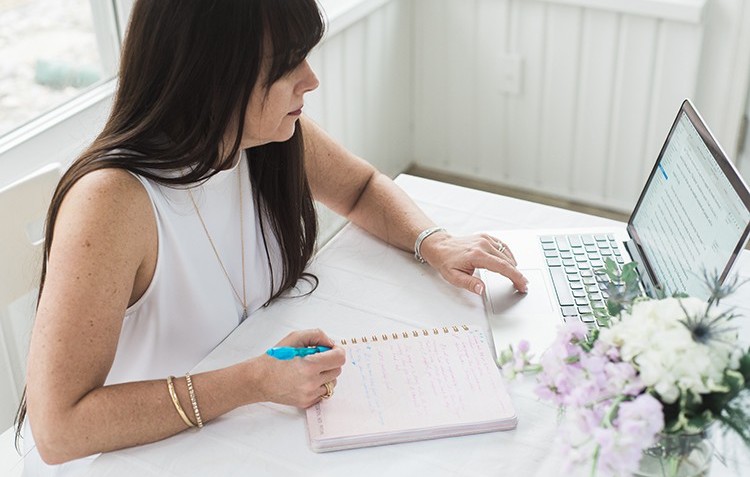
The data backs this up. A recent study published in the Journal of Psychiatric Nursing found that adults who took up a hobby showed a 272% increase in their odds of recovering from depression. The American Psychological Association reports that 46% of Americans use creative activities specifically to relieve stress or anxiety. And trend analysts have noted that the “kidult” market—adults buying toys and collectibles for themselves—has become one of the fastest-growing segments in the consumer goods industry.
Why? What’s driving intelligent, capable adults toward these seemingly simple pleasures?
The answer, I believe, lies in something psychologists call “flow state”—that magical condition where you become so absorbed in what you’re doing that time seems to stop. Where the endless mental chatter finally, mercifully, quiets. Where your hands know what to do even when your mind doesn’t.
When we immerse ourselves in something like customizing a doll, or carefully selecting an outfit, or positioning a figure just so for a photograph—we’re not escaping reality. We’re accessing a different part of ourselves. The part that existed before deadlines and notifications and the constant low-level anxiety of modern existence. The part that remembers what it feels like to make something beautiful simply because it’s beautiful.
This isn’t escapism. It’s return.
Now I want to talk about something that might seem oddly technical for a piece about creativity and wellbeing: the material your doll is made from.
Stay with me here, because this matters more than you might expect.
For years, the doll industry has been dominated by cheap plastics—primarily ABS (acrylonitrile butadiene styrene), the same hard plastic used in LEGO bricks and computer keyboards. It’s inexpensive to manufacture, easy to mold, and perfectly adequate for toys that will be played with roughly and eventually discarded.
But collectors aren’t looking for adequate. Artists aren’t looking for disposable. And anyone seeking that therapeutic, sensory experience of working with their hands deserves something that feels good to touch.
This is where vinyl changes everything.
Premium vinyl—the material we’ve built our entire operation around at This Is Blythe—has a fundamentally different character. It’s softer to the touch, with a subtle flexibility that mimics the give of real skin. It doesn’t have that harsh plastic smell that so many collectors complain about (we receive messages about this constantly from people who’ve ordered from other sources). It ages gracefully, developing a subtle patina over decades rather than becoming brittle or discolored. And most importantly, it holds paint and customization work beautifully, allowing for the kind of detailed artistic expression that transforms a manufactured object into something genuinely personal.
I should mention something here that we don’t often talk about publicly: we are the only Blythe company in the world committed exclusively to premium vinyl construction.
This isn’t marketing hyperbole. It’s simply the reality of our operation. When This Is Blythe was founded in 2000, we made a decision that seemed almost foolish from a business perspective: we would use only the highest-quality materials, even when cheaper alternatives would have been perfectly acceptable to most customers. We developed our own custom-patented limbs and joints. We invested in fiber hair that’s light-years beyond the tangled, synthetic masses you find in bargain bins. We insisted on construction methods that take longer and cost more, because we believed that collectors deserved better.
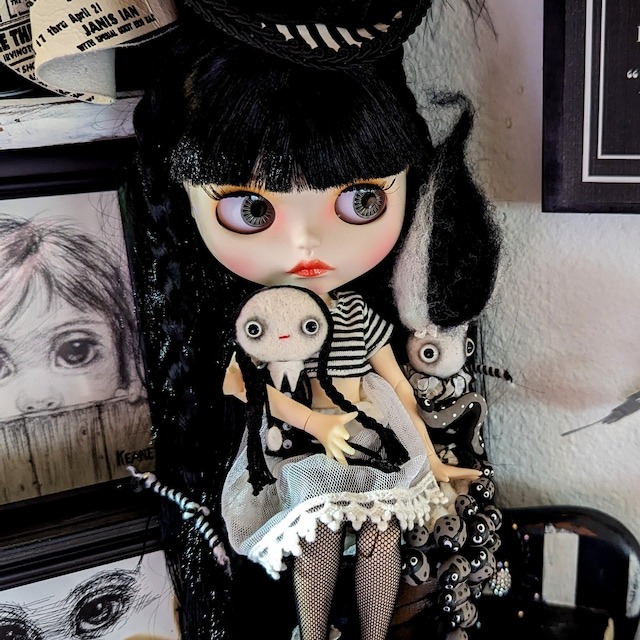
Twenty-five years later (26 soon!), I think we’ve been vindicated. Our dolls don’t just look better—they feel better in your hands. They don’t emit chemical odors. They hold their value and appreciate over time (more on that later). They become the kind of objects you want to keep forever, rather than the kind you eventually throw away.
And perhaps most importantly: they provide a sensory experience that actually supports that therapeutic, flow-state creative work we talked about earlier. There’s a reason our customers describe running their fingers through their Blythe’s mohair as “more therapeutic than any meditation app.” The materials matter. The quality matters. What you hold in your hands matters.
I want to share some research that doesn’t get nearly enough attention.
In 2020, researchers conducting a longitudinal study spanning 12 years discovered something remarkable about the relationship between toy hobbies and mental health. Adults with depression who took up a hobby were nearly three times more likely to recover than those who didn’t. Perhaps even more striking: people who engaged in hobbies were 32% less likely to develop depression in the first place.
Think about that for a moment. A simple hobby—not medication, not intensive therapy, just a regular creative practice—functioning as a kind of psychological shield against one of the most common mental health challenges of our time.
But it gets more interesting. Subsequent studies have begun to unpack exactly why hobbies seem to have this protective effect, and the mechanisms they’ve identified map perfectly onto the Blythe collecting experience:
Recognition and community. Researchers found that creative hobbies that involve sharing your work with others—and receiving recognition for it—have stronger therapeutic effects than solitary pursuits. The Blythe community, with its vibrant Instagram presence, Facebook groups, and international meetups, provides exactly this kind of supportive, appreciative audience. When you post a photo of your Blythe and fellow collectors respond with genuine enthusiasm, that’s not just social media validation—it’s actually supporting your mental health.
Tactile engagement. Studies consistently show that hands-on activities—those involving physical manipulation of objects—activate the parasympathetic nervous system more effectively than purely mental pursuits. This is the body’s “rest and digest” system, the physiological opposite of the fight-or-flight stress response. When you’re changing your Blythe’s outfit, styling her hair, or positioning her for a photograph, you’re literally activating the part of your nervous system responsible for calm and recovery.
Mastery and learning. The process of developing new skills—even seemingly simple ones, like learning to disassemble and reassemble a Blythe doll or create custom accessories—creates a sense of competence and progression that buffers against feelings of helplessness and stagnation. Every new technique mastered, every successful customization project, becomes evidence that you’re capable of growth and achievement.
Present-moment awareness. Perhaps most importantly, absorbing creative work demands attention in a way that naturally crowds out rumination and worry. You cannot be catastrophizing about tomorrow’s meeting while you’re carefully painting eyeliner on a one-inch face. The hobby becomes a form of meditation by stealth—mindfulness practice disguised as play.
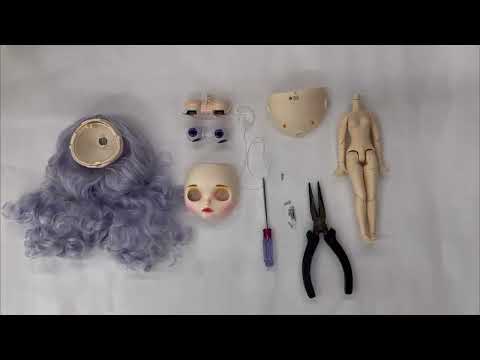
Learning new skills creates a sense of mastery that supports mental wellbeing.
I want to be careful here not to overstate the case. Blythe collecting isn’t a replacement for professional mental health treatment when that’s what’s needed. But as a complementary practice, as a tool for everyday stress management and creative expression, the evidence suggests it’s remarkably effective. And the testimonials we receive from customers—thousands of them over the years—bear this out in deeply personal ways.
When photographer Gina Garan published her now-legendary photo book “This Is Blythe” in 2000, she couldn’t have known she was igniting a global phenomenon. The book—featuring her haunting, whimsical photographs of vintage Blythe dolls—sold over 100,000 copies and introduced an entirely new generation to these peculiar, big-eyed figures that Kenner had briefly produced (and quickly discontinued) back in 1972.
That same year, inspired by the resurgence of interest, This Is Blythe was born.
We started small—impossibly small, really, by today’s standards. A handful of dolls. A simple website. A conviction that these strange, beautiful objects deserved better than they were getting from the market at the time.
Twenty-five years later, we’ve grown into the world’s largest custom Blythe doll company, with over 6,000 products in our catalog and customers in more than 150 countries. We’ve been featured in Forbes, Vogue, The Guardian, BBC, and countless other publications. We’ve watched our earliest customers become accomplished artists and small business owners. We’ve seen children who received their first Blythe as gifts grow into adults who still treasure those original dolls.

What have we learned from all this time?
First: quality is the only thing that lasts. Trends come and go. Fads flare and fade. But when you build something with genuine craftsmanship—when you refuse to cut corners even when no one would notice—you create objects that people keep for decades, that appreciate in value, that get passed down to the next generation. Our commitment to premium vinyl and original parts has never wavered, and we believe that’s why we’re still here, still growing, when so many competitors have come and gone.
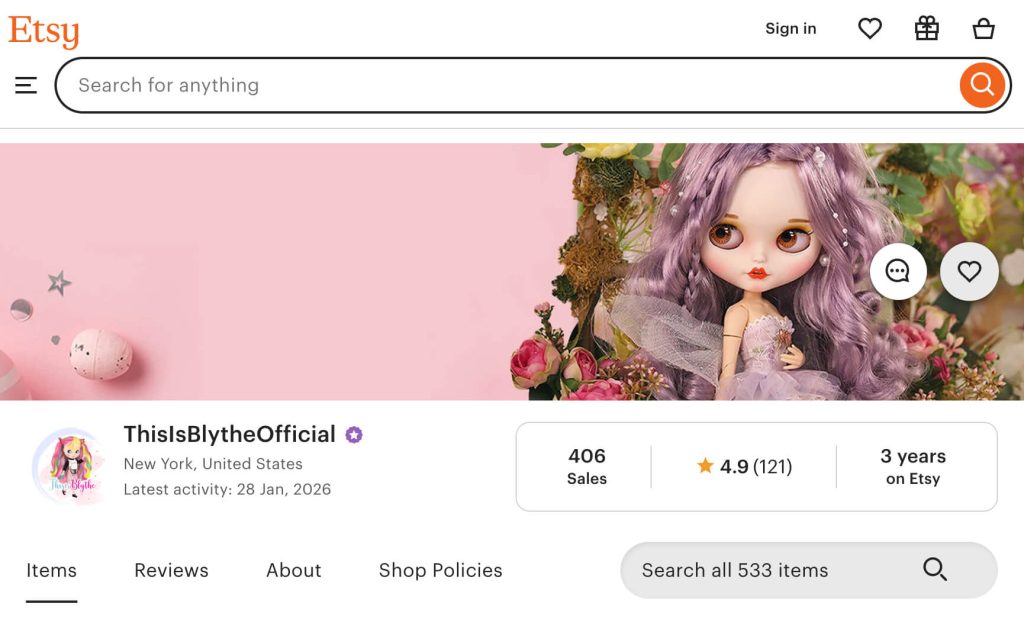
Second: community is everything. We don’t just sell dolls—we nurture a global family. Our Etsy shop maintains a 4.9-star rating with Star Seller status, not because we’re perfect, but because we genuinely care about every single customer’s experience. We respond to messages quickly. We solve problems generously. We remember that behind every order is a real person with real hopes for what this hobby might bring them.
Third: this hobby changes people. Not in dramatic, overnight ways, necessarily—but in quiet accumulations that add up to transformation. The anxious person who discovers that photographing her Blythe collection brings unexpected peace. The retiree who finds that customizing dolls gives her a creative outlet she didn’t know she needed. The child who learns patience and precision through this gentle hobby, skills that serve them throughout their lives. We’ve witnessed thousands of these stories unfold, and they never stop moving us.
Let’s talk about something practical for a moment: money.
We don’t advocate buying Blythe dolls purely as investments—that’s not what this hobby is about, and anyone who tells you otherwise is probably trying to sell you something. But it would be dishonest not to acknowledge the remarkable financial appreciation that well-maintained Blythe collections have shown over the decades.
Consider the original 1972 Kenner Blythe dolls. When they were briefly sold in the early ’70s, they retailed for about $3.99. Today, those same dolls—in good condition with original packaging—routinely sell for $3,000 to $8,000. That’s not a typo. We’re talking about appreciation rates of 75,000% to 200,000% over fifty years.
Now, not every doll becomes a Kenner-level investment. But the broader trend is clear: quality Blythe dolls, particularly custom pieces with documented provenance, tend to hold and increase their value over time. This is especially true for:
The market for collectible dolls has matured significantly. We now see standardized grading systems, authentication services, and serious collectors who approach their acquisitions with the same discipline they’d apply to fine art or vintage wines. The investment potential is real, even if it shouldn’t be your primary motivation.
What’s perhaps more interesting is the secondary market that’s developed around Blythe customization. Skilled customizers—many of whom started as hobbyists with our DIY kits—now command prices of $500 to $10,000+ for their one-of-a-kind creations. Some have built full-time businesses. Others maintain waiting lists that stretch for years. The hobby has created real economic opportunity for creative people around the world.

But here’s what I find most compelling about the value proposition: unlike almost everything else you can buy, a Blythe doll gives you something while you own it. A stock certificate sits in an account somewhere, generating (hopefully) returns but providing no daily joy. A vintage car might appreciate, but the maintenance costs and garage space and anxiety about scratches can outweigh the pleasure. Your Blythe sits on your desk, travels with you on adventures, provides countless hours of creative enjoyment, and then potentially appreciates in value too. You get to have your cake and eat it too, to use a tired but apt metaphor.
If you’ve read this far, you’re either already part of our community (in which case, hello again, and thank you for being here) or you’re seriously considering taking the plunge. For those in the latter category, let me offer some guidance.
For absolute beginners:
Start with something that speaks to you aesthetically. Don’t overthink it. Browse our bestsellers collection and notice which faces make you pause, which hair colors catch your eye, which expressions seem to speak to something inside you. The intellectual justifications can come later; the initial connection should be visceral.
Our Petite Blythe dolls (4 inches tall) and Middie Blythe dolls (8 inches tall) offer a wonderful, accessible entry point. They’re more affordable, take up minimal space, and provide all the charm and customization potential of their larger siblings. Many serious collectors started with a Petite on their desk and found themselves gradually expanding from there.
If you want the full experience immediately, our Custom Neo Blythe Full Sets arrive complete with outfits and accessories, ready for display or photography right out of the box. These are the 12-inch dolls that most people picture when they think of Blythe—the oversized heads, the color-changing eyes, the infinite customization possibilities.
For those who want to create:
Our Custom Blythe Doll Making DIY Kit is specifically designed for people who want to learn the craft of Blythe customization from the ground up. You’ll receive everything you need to build and personalize your own doll, transforming a blank canvas into something uniquely yours. It’s deeply satisfying work, and many of our most accomplished artist-collectors started exactly this way.
For experienced collectors:
You already know what you’re looking for, but let me point out a few things you might have missed. Our OOAK (One-Of-A-Kind) customs are created by hand-picked professional Blythe customizers, with some pieces taking up to a month to produce. Each one is completely unique—there has never been another like it, and there never will be. For collectors seeking true exclusivity, these are the crown jewels.
Also worth exploring: our extensive selection of premium hair, eye chips, faceplates, and other customization supplies. Even if you don’t plan to do major custom work yourself, swapping out hair or eyes can dramatically transform a doll’s personality.

I’ve saved perhaps the most important element for near the end: the people.
When you acquire a Blythe doll, you’re not just getting an object. You’re receiving a key to one of the warmest, most supportive creative communities on the internet—and, increasingly, in the real world as well.
Our Instagram community is a constantly updating gallery of inspiration, where collectors share their photography, customization projects, and styling experiments. The skill levels range from complete beginners posting their first tentative photos to professional artists whose work belongs in galleries. Everyone encourages everyone. Snobbery is essentially nonexistent. Newcomers are welcomed with genuine enthusiasm.
Facebook groups provide spaces for more in-depth discussion, trading, troubleshooting, and the kind of extended conversations that don’t fit Instagram’s format. Questions get answered quickly and thoroughly. Advice is offered generously. Virtual friendships—and sometimes real-world ones—form across continents and time zones.
And then there are the physical gatherings: BlytheCon, regional meetups, doll shows, and informal coffee shop sessions where collectors bring their favorites to share. These events have a particular magic that’s hard to describe if you haven’t experienced it. Imagine a room full of people who genuinely understand why you spent three hours perfecting your doll’s tiny hairstyle, because they’ve done exactly the same thing. The relief of not having to explain yourself, of being among your people—it’s remarkably powerful.
I’ve heard from collectors who say the community helped them through divorces, job losses, serious illnesses, and the grinding isolation of the pandemic years. That might sound like exaggeration, but I believe them completely. Human beings need connection and belonging; we need to be seen and appreciated for who we really are. This community provides that, often to people who weren’t finding it elsewhere.
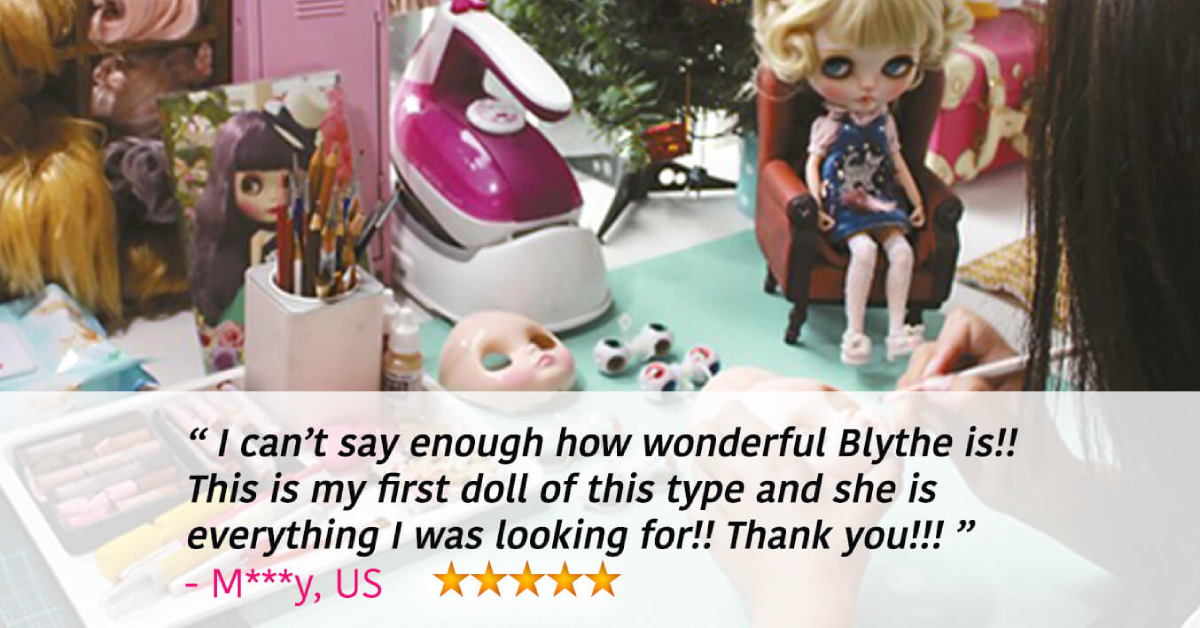
If you do decide to join us—whether through a first purchase or a return visit—I want you to know exactly what you can expect. We’ve spent 25 years earning trust, and we take that responsibility seriously.
On quality: Every doll we sell is made with our premium vinyl construction and original parts. No chemical smells. No cheap plastics. No cutting corners. We stand behind everything we offer with a 30-day money-back guarantee, no questions asked.
On service: We maintain a 4.9 rating on Reviews.io and 4.8 on Trustpilot for a reason: we actually care. Our customer support team responds within hours, not days. We solve problems generously, erring on the side of the customer when situations are ambiguous. Your satisfaction genuinely matters to us.

On shipping: We offer free worldwide shipping on all orders, with tracking. We handle customs documentation properly so you’re not surprised by unexpected fees. We pack carefully, because we know how much your purchase means to you.
On security: We use industry-standard secure payment methods and provide free $100,000 Shopper Identity Protection after every purchase. Your financial information is safe with us.
On being here: We’ve been in business for 25 years. We’re not a fly-by-night operation that might disappear tomorrow. When you buy from This Is Blythe, you’re buying from a company with deep roots, proven staying power, and every intention of being here for decades to come.
I called this piece “The Quiet Revolution,” and I want to explain what I mean by that.
Revolutions, in the popular imagination, are loud and dramatic. They involve crowds and conflict and sudden, visible change. But the most significant revolutions are often the quiet ones—the gradual shifts in how people think and feel and spend their time that accumulate into something profound.
The revolution I’m describing is this: people are remembering how to slow down. They’re rediscovering the pleasure of making things with their hands. They’re finding communities that accept and appreciate them. They’re building practices into their lives that buffer against stress and anxiety and the endless noise of modern existence.
Blythe dolls are one small part of this larger movement, but they’re a part we’re proud to represent. For 25 years, we’ve watched these peculiar, big-eyed figures serve as catalysts for creativity, connection, and calm. We’ve seen them help people through difficult times and celebrate good ones. We’ve witnessed complete beginners blossom into confident artists, and solitary individuals find lasting friendships.
The revolution is quiet because it happens one person at a time, in private moments—a collector arranging her dolls before bed, a customizer perfecting a tiny detail, a photographer capturing something beautiful in miniature. But added together, these moments represent something significant: a collective decision to make room for gentleness and creativity and play in lives that often leave little space for such things.
You’re invited to be part of it.
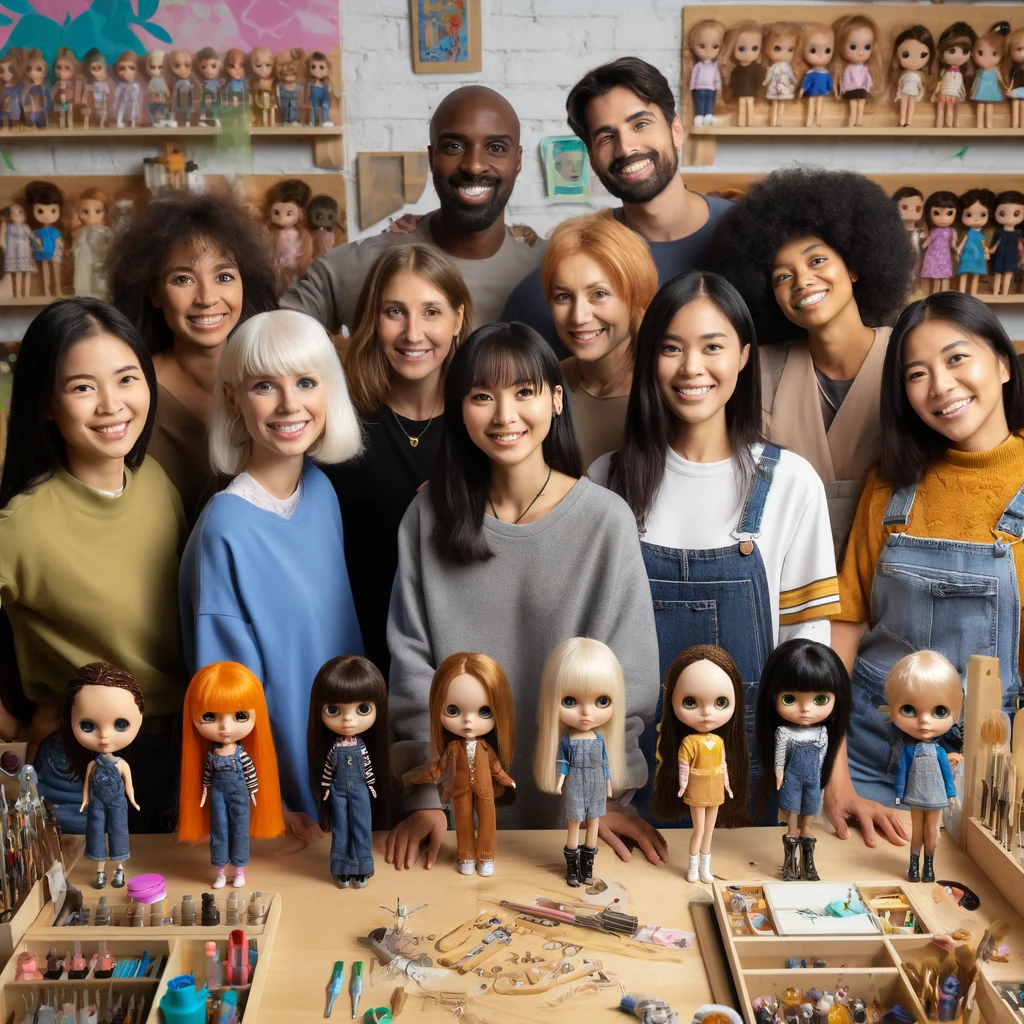
If you’ve made it all the way to the end of this rather long meditation on dolls, creativity, and finding peace—thank you. Truly. In an age of skimming and scrolling, the gift of sustained attention is a rare and precious thing.
As a token of appreciation for your time, I’d like to offer you something. Use the code below on your next order—it’s my way of saying thank you, and a small encouragement to take whatever next step feels right for you.
Whether you’re ready to browse our collection, visit our Etsy shop, or simply follow along on Instagram until the moment feels right—welcome. We’re glad you’re here.
May you find whatever quiet revolution you’re seeking.
With gratitude,
Jenna Anderson
The Blythe Whisperer
Customer Service Enchantress
This Is Blythe
🎁 Thank You Gift for Our Readers
Use this exclusive code on your next order:
⏰ This code expires in:
Days
Hours
Minutes
Seconds
Before we wrap up, I want to share a few stories that have stayed with me. These are real people—their names have been changed for privacy—but their experiences are absolutely genuine.
Sarah, 34, Marketing Executive from Chicago:
"I discovered Blythe during the worst burnout of my career. I was working 70-hour weeks, barely sleeping, forgetting to eat. My therapist suggested I find something—anything—that wasn't work-related. I stumbled across a Blythe photography account on Instagram and felt something I hadn't felt in months: curiosity. Pure, simple curiosity about something that had nothing to do with spreadsheets or quarterly reports.
I bought my first doll on impulse. When she arrived, I sat with her for an hour, just looking at her face, changing her eye colors, running my fingers through her hair. It was the first hour in months where I wasn't thinking about work. That one hour became a daily ritual. Two years later, I have a collection of twelve, a thriving Instagram account, and—most importantly—boundaries. Blythe taught me that I was allowed to have a life outside of my job."
Roberto, 67, Retired Teacher from São Paulo:
"When my wife passed away three years ago, I didn't know what to do with myself. Forty years of marriage, and suddenly I was alone in a house full of her things but empty of her presence. My granddaughter—she was twelve at the time—showed me her Blythe doll, and something about those big eyes reminded me of my wife when she was young. Always looking at the world with wonder.
I asked my granddaughter to teach me about Blythe dolls. She was delighted—finally, something we could share! Now we collect together. We go to meetups. We take photographs. I've made friends my own age through the community, people who understand loss and have found ways to keep creating anyway. The hobby didn't replace what I lost, but it gave me a way forward."
Min-Ji, 28, Software Developer from Seoul:
"I have social anxiety. Real conversation is difficult for me—I never know what to say, and I spend hours afterward analyzing every word I spoke, convinced I made a fool of myself. But photographing my Blythe dolls and sharing the images online? That I can do. I can express myself through the scenes I create, the stories I tell with my photographs.
The Blythe community accepted me without question. They respond to my photos with enthusiasm and warmth. Slowly, I've started having actual conversations in the comments, then in direct messages, then in video calls. Last month I attended my first in-person meetup. I was terrified, but everyone was so kind. For the first time in my life, I have friends who know the real me—and the dolls made that possible."
These stories repeat, in infinite variations, across our community. Different ages, different countries, different struggles—but the same discovery: that this seemingly simple hobby can be a doorway to something much larger.
I've shared philosophy and stories, but let me also give you something concrete. If you're ready to begin your Blythe journey, here's a practical roadmap:
Week 1: Explore and Dream
Week 2: Make Your First Acquisition
Week 3-4: Settle In
Month 2 and Beyond: Grow at Your Own Pace
The most important advice I can give: don't overthink it. This hobby rewards spontaneity and emotional response. The doll that catches your eye is usually the right one. The creative impulse you have at 11 PM is usually worth following. The photograph that feels "not good enough" is usually more beautiful than you realize.
Trust yourself. Trust the process. Trust that this strange, wonderful hobby has something to teach you.
© 2026 This Is Blythe. All rights reserved. Established 2000.
The world's leading custom Blythe doll company for 25 years.

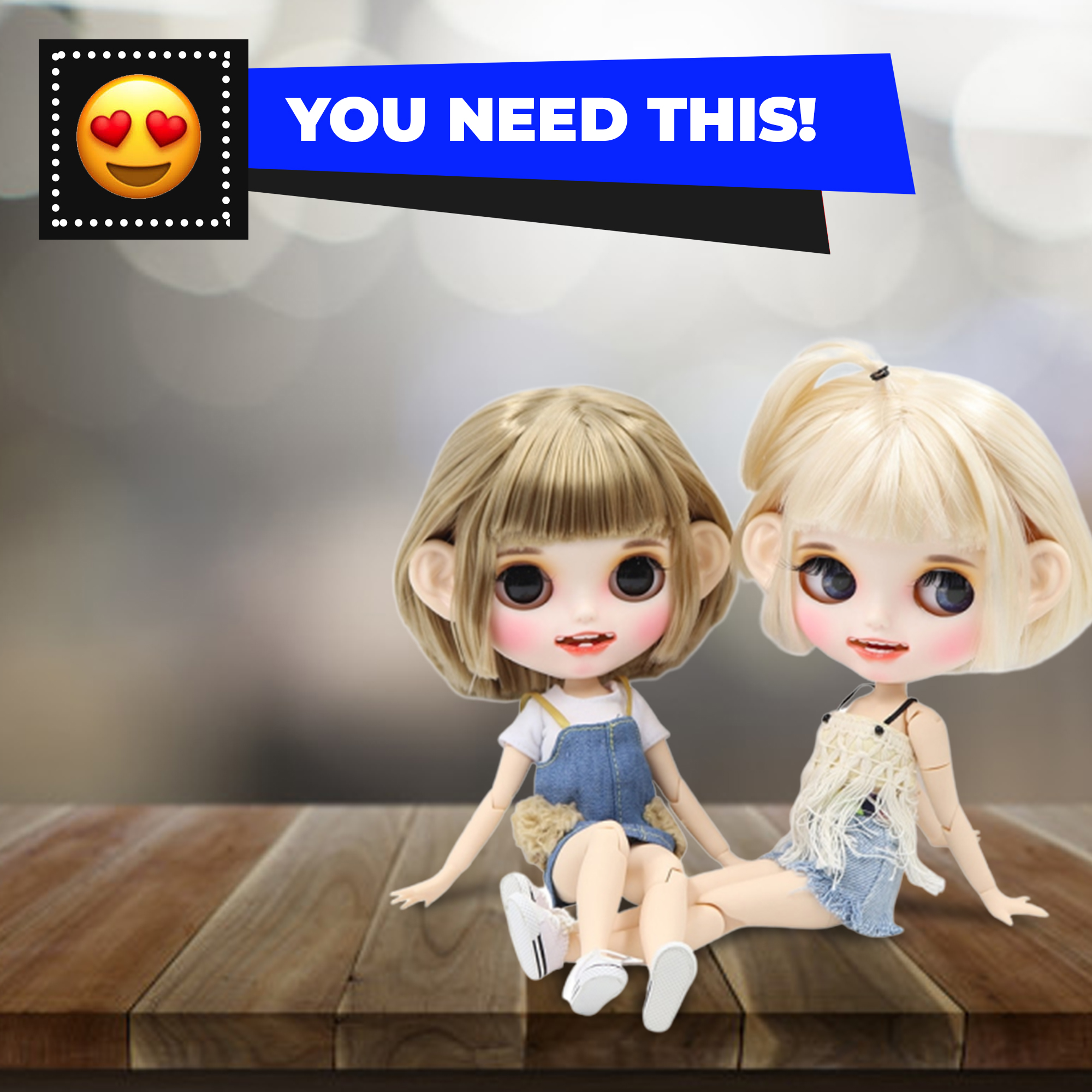


Say hello to Jenna Anderson — our Customer Happiness Director and resident Blythe doll devotee. Affectionately known around the studio as the “Blythe Whisperer,” Jenna spends her days helping collectors find the doll that feels unmistakably theirs, and her evenings writing the stories you read here. Her warmth, eye for detail, and genuine love of these big-eyed characters make her the heart of the This Is Blythe community.
When she steps away from the inbox, you'll find her sewing tiny doll-sized accessories, behind a camera, or lost in some new arts-and-crafts project — the same curiosity and care she pours into every doll. Read more about Jenna's journey into the world of Blythe here.
New posts, doll drops & members-only deals — straight to your inbox.
No spam, just dolls. Unsubscribe anytime.
Here's your code — tap copy, then use it at checkout.
Your welcome code
BFF26BYNWUse it on any new order — we've emailed it to you, too. Every order ships free worldwide with a 30-day guarantee. 💕
Free Worldwide Shipping | 30-Day Money-Back Guarantee
© 2026 This Is Blythe Official Website. All rights reserved.
The world’s top custom Blythe doll maker since 2000.
Cookie Policy | Accessibility Statement | Do Not Sell or Share My Personal Information | Ethics & Compliance | GDPR & CCPA Compliance | Data Processing Agreement | Trust Certificate | DMCA





Leave a comment