Five icons, five very different personalities. An honest, side-by-side guide for collectors, artists and anyone who just fell down the doll rabbit hole.

If you have spent any time on social media in the last two years, you have watched grown adults queue around the block for a small, toothy monster in a blind box, clip it to a designer handbag and call it a personality. Labubu turned collectible toys into a global conversation. At the same time, Barbie reminded the world in 2023 that dolls can be smart, funny and very much for adults.
Somewhere in that conversation, a lot of people discover Blythe, the doll with the giant head and eyes that change colour, and the questions start. Is she like Barbie? Is she like a Pullip? Is she a BJD? Is she the “grown-up Labubu”?
I am Jenna from This Is Blythe. We have been making custom Blythe dolls since 2000, so yes, I am biased, and I will tell you where. But I also love every one of these dolls for what it is, and choosing the wrong one is the fastest way to fall out of love with a hobby. So here is the honest comparison I give in our chat, from Blythe vs Barbie to Labubu, Pullip and BJDs.
Table of Contents
This is not just a feeling. According to Circana’s global toy market report, collectibles grew 32% in 2025 and now make up almost a fifth of all toy sales worldwide, and nearly 40% of European consumers bought a toy for themselves or another adult last year. Pop Mart, the company behind Labubu, reported around US$2 billion in sales in the first half of 2025.
Adults are not buying toys by accident. They are buying small pieces of joy, art and identity. The question is which one fits you.
| Blythe | Barbie | Labubu | Pullip | BJD | |
|---|---|---|---|---|---|
| What she is | Big-eyed fashion doll | Classic fashion doll | Collectible art toy | Big-headed fashion doll | Ball-jointed resin doll |
| First released | 1972 | 1959 | 2015 | 2003 | Late 1990s |
| Typical size | About 28 cm | About 29 cm | Pocket to giant | About 30 cm | 26 to 70 cm |
| Signature feature | Eyes change colour | Fashion and careers | Mischievous grin | Eyes move, lids blink | Lifelike poseability |
| How you buy | Choose or customize | Shop shelves | Blind boxes | Collector releases | Order and assemble |
| Customizing | Huge scene | Popular | Mostly displayed | Popular | Huge scene |
| Best for | Personal look-alikes, art | Fashion, nostalgia | Fun, fashion charms | Anime and kawaii fans | Serious art collectors |
Now the long version.

Blythe has the best origin story in the doll world. She was released by the American toy company Kenner in 1972, sold for a single year and disappeared. Children found her giant head and colour-changing eyes a bit too strange. Decades later, a New York photographer named Gina Garan began photographing her own Blythe around the world, her photos became a book, and a new generation of Blythe dolls followed in 2001. The doll that flopped with kids became a cult favourite for adults. Our story of Blythe dolls tells the full history.
What makes her unique is the eye mechanism. Pull a string at the back of her head and her eyes change colour, from green to amber to purple to pink, while her gaze moves from side to side.
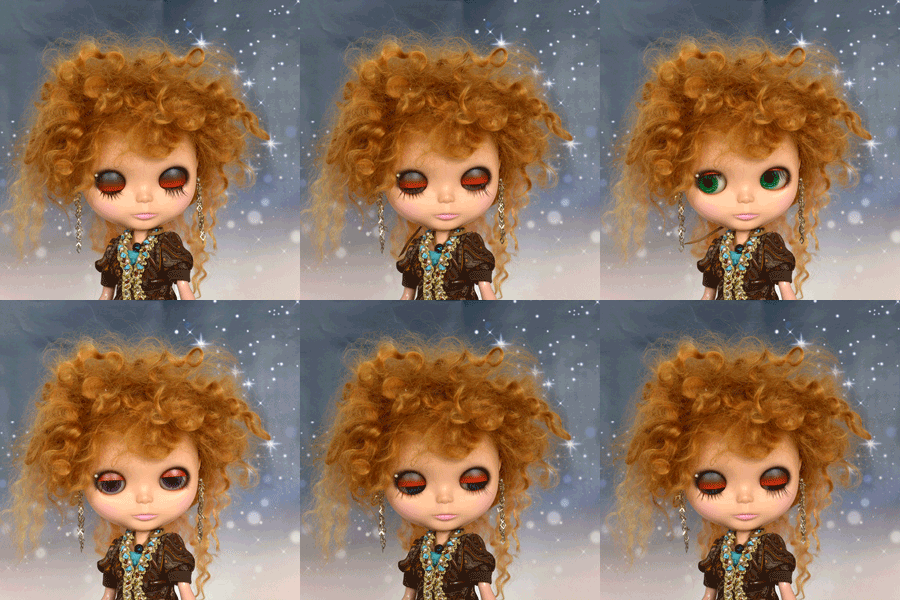
Blythe is also the most personal of the five, because her large, simple face is a perfect canvas. Artists sand, carve and paint the face, swap the eye chips and restyle the hair, which is why look-alike dolls are such a big part of the Blythe world. At This Is Blythe, every doll is hand-finished by our artists, and our free look-alike finder matches a doll to your photo.
There are three sizes. Neo Blythe is the classic, about 28 cm tall. Middie Blythe is smaller, with a side-glancing eye moved by a slider and a tilting head, and Petite Blythe is the tiniest, with sleepy eyes that close when you lay her down.

Meet the world-famous Blythe doll
Choose Blythe if: you want a doll that feels like a person, a look-alike of yourself or someone you love, or a canvas for art and photography.
Barbie is the most famous doll on earth, launched by Mattel in 1959. She is a fashion doll in the truest sense: slim, about 29 cm tall, with a huge wardrobe, hundreds of careers and a cultural footprint that got its own blockbuster film.
In the Blythe vs Barbie question, the difference is mostly about the face. Barbie has a small, sculpted face designed to look like a fashion model, while Blythe has an oversized head with a large, flat face and big mechanical eyes. That changes everything about how people use them.
People who customize Barbie usually restyle the hair and repaint the face, and it is a wonderful craft. But if you want a doll that looks like a specific person, Blythe is usually easier, because her big face leaves room for the details that make someone recognisable: brows, freckles, lip colour, eye colour. Our custom Blythe doll page shows what that looks like in practice.
Many collectors own both, so Blythe vs Barbie is not really a battle. They are friends, not rivals.

Choose Barbie if: you love fashion dolls, nostalgia and storytelling. Choose Blythe if: you want the doll to feel like someone.
Labubu is not a doll in the traditional sense. She is a collectible art toy created by the Hong Kong-born illustrator Kasing Lung, part of a series called The Monsters inspired by Nordic folklore. Labubu first appeared in 2015, joined Pop Mart in 2019, and exploded in 2024 when Lisa from Blackpink was photographed with one clipped to her bag. Most Labubus are sold in sealed blind boxes, so you do not know which one you will get until you open it.
That is the thrill, and also the reason so many people now search for a Labubu alternative. Blind boxes are fun, but they are also random, prices on the resale market can be wild, and after the fifth duplicate, some collectors want something they actually get to choose.
Here is how Blythe compares:
The thing they share is the feeling. Both are joyful, a little bit odd, very collectible and loved by adults who never stopped liking cute things. If you love Labubu for the fun and the fashion, keep loving her. If you are ready for something more personal, try a Blythe.

Choose Labubu if: you love surprise, fashion charms and the thrill of the hunt. Choose Blythe if: you want to choose, customize and keep.
Pullip is Blythe’s closest cousin, and the comparison collectors argue about most. She was created in South Korea in 2003, first marketed by Jun Planning in Japan and later made by Groove. Like Blythe, she is about 30 cm tall with an oversized head on a slim body.
The big difference is the eyes. Pullip’s eyes move from side to side and her eyelids blink, controlled by small levers at the back of her head. Blythe’s eyes change colour with a pull string. Pullip’s face is also more sculpted and doll-like, with a small chin and a more anime-inspired look, while Blythe’s face is broader and more vintage.
In practice:

Choose Pullip if: you love blinking eyes, anime style and themed releases. Choose Blythe if: you want colour-changing eyes and a face that is easy to make personal.
BJD stands for ball-jointed doll. These are usually made of resin, strung together with elastic through ball joints at the shoulders, elbows, hips and knees, which makes them very poseable and very lifelike. The modern BJD hobby grew in Japan and South Korea from the late 1990s, and today there are dozens of artist studios.
BJDs come in many sizes, from about 26 cm up to around 70 cm, and they are often sold in parts. Collectors choose a head, a body, a wig, eyes and a face-up, and assemble their own doll. It is a deep, beautiful and often expensive hobby that rewards patience.
Compared with BJDs, Blythe is lighter, easier to start with and much easier to display in a small space. BJD resin also needs a bit more care, since it can yellow over time in sunlight.

Choose a BJD if: you want sculptural realism and enjoy assembling a doll from parts. Choose Blythe if: you want something charming, compact and ready to love the day she arrives.
The most interesting thing about all five of these dolls is what happens after they leave the box. Every one of them has a community of artists who change, restyle and reimagine them.
If you are an artist, any of these will give you a canvas. If you want a doll that becomes a portrait of a real person, Blythe’s big, simple face is the friendliest canvas of them all. You can even start with our custom Blythe doll making kit and make your very first face-up this winter.


This Is Blythe, 25 years of custom doll magic and the story behind 100,000+ smiles
Honestly? The one that makes you smile every time you walk past the shelf. But here is how I would think about it.
And if you are buying a gift, Blythe has one big advantage: you can match her to the person. That is very hard to do with a blind box.
This is a fantastic doll that I would recommend to anyone! I made an unboxing review video for my 1st EVER Blythe doll, so excited!Josephina, Finland

Unboxing a first ever Blythe doll, by Josephine’s Creatures
There is a reason this is happening now. A 2024 study from Anglia Ruskin University of more than 7,000 adults found that people who did arts and crafts reported higher happiness and life satisfaction, and a stronger sense that life is worthwhile. Collecting, styling and photographing dolls is a creative hobby that fits on a desk, needs no talent to start and gives you something beautiful to look at at the end of a long day.
Our collectors say the same thing in their own words. Jennifer in the United States wrote, “I will definitely buy more Blythes to add to my collection!” A buyer in the UK, on her second doll: “Annie was the perfect addition to my room. She’s like a baby to me!!”

If this guide has tipped you towards Blythe, here is the easiest way in:
Whichever doll you choose, welcome to the club. It is a very nice club. The members have excellent taste and very small shoes.
Keep reading
With love, This Is Blythe Team
Say hello to Jenna Anderson — our Customer Happiness Director and resident Blythe doll devotee. Affectionately known around the studio as the “Blythe Whisperer,” Jenna spends her days helping collectors find the doll that feels unmistakably theirs, and her evenings writing the stories you read here. Her warmth, eye for detail, and genuine love of these big-eyed characters make her the heart of the This Is Blythe community.
When she steps away from the inbox, you'll find her sewing tiny doll-sized accessories, behind a camera, or lost in some new arts-and-crafts project — the same curiosity and care she pours into every doll. Read more about Jenna's journey into the world of Blythe here.
New posts, doll drops & members-only deals — straight to your inbox.
No spam, just dolls. Unsubscribe anytime.
Here's your code — tap copy, then use it at checkout.
Your welcome code
BFF26BYNWUse it on any new order — we've emailed it to you, too. Every order ships free worldwide with a 30-day guarantee. 💕
Free Worldwide Shipping | 30-Day Money-Back Guarantee
© 2026 This Is Blythe Official Website. All rights reserved.
The world’s top custom Blythe doll maker since 2000.
Cookie Policy | Accessibility Statement | Do Not Sell or Share My Personal Information | Ethics & Compliance | GDPR & CCPA Compliance | Data Processing Agreement | Trust Certificate | DMCA








Leave a comment