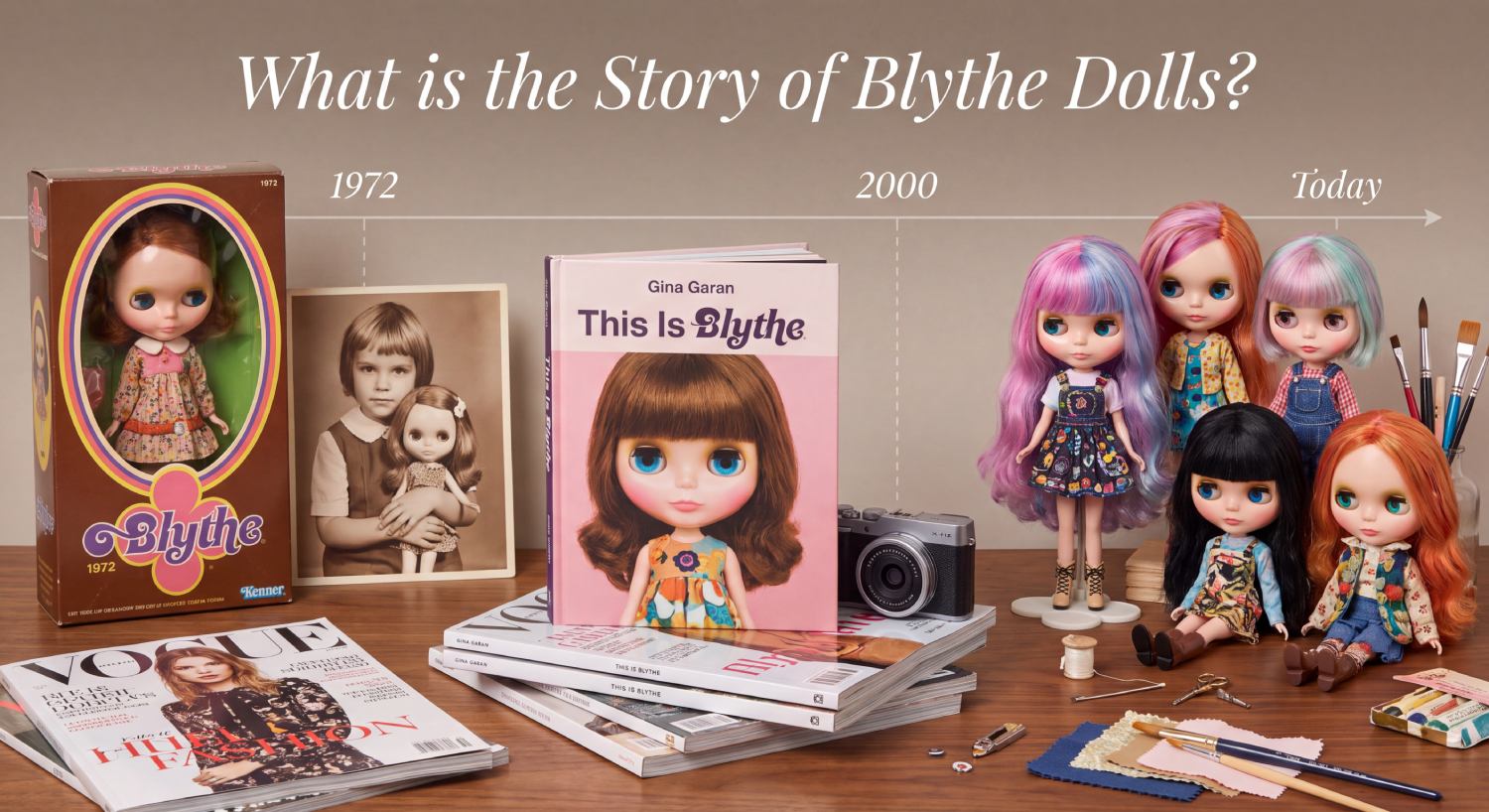
The story of Blythe dolls begins in 1972, when designer Allison Katzman created a big eyed fashion doll for the Kenner toy company. Children found her strange, sales flopped, and Blythe was discontinued within a year. Almost three decades later, photographer Gina Garan rediscovered her, Japan began producing new editions in 2001, and the custom Blythe movement turned a failed 1970s toy into one of the most loved collector dolls in the world.
| Year | What happened |
|---|---|
| 1972 | Kenner releases Blythe in the United States, designed by Allison Katzman, with color changing pull string eyes |
| 1973 | Blythe is discontinued after roughly one year of weak sales |
| Late 1990s | New York photographer Gina Garan begins photographing her vintage Blythe around the world |
| 2000 | The book This Is Blythe is published, a Blythe stars in a TV commercial for the Japanese department store Parco, and This Is Blythe begins its journey as a company |
| 2001 | New Blythe editions enter production in Japan, and the modern era begins |
| 2000s to 2010s | The custom Blythe movement explodes: artists carve, paint, and reroot dolls into one of a kind pieces |
| Today | Blythe is collected in every corner of the world, vintage 1972 dolls sell for four figures, and This Is Blythe marks 26 years of handmade custom dolls |
Blythe was designed by Allison Katzman, working at the legendary toy design firm Marvin Glass and Associates, and produced by the American toy company Kenner in 1972. Katzman drew on the big eyes art style popular in the late 1960s and early 1970s, giving the doll her oversized head and enormous eyes that change color and gaze with a pull string, a mechanism that remains unique to Blythe half a century later.
The name was a fitting choice for a doll meant to charm: Blythe is an old English word meaning joyful and carefree, a history we unpack in our Blythe meaning guide.
The 1970s toy aisle was not ready for her. Children of the era reportedly found the oversized head and shifting eyes unsettling rather than enchanting, and parents passed her over for safer choices. Kenner pulled the line after roughly one year. It is one of the great ironies of toy history: the exact features that scared children in 1972, the huge eyes, the changing gaze, the strange beauty, are precisely what adult collectors fell in love with decades later.
For almost thirty years, Blythe lived in attics, flea markets, and thrift stores. Slowly, a quiet cult following formed among doll collectors who recognized something special in her. Because the original run lasted only one year, surviving Kenner Blythes became genuinely scarce, and scarcity plus love is how a discontinued toy becomes a grail. Today original 1972 dolls in good condition sell for four figures, a market we break down in our Blythe doll price guide.
The turning point was a photographer, not a toy company. In the late 1990s, New York producer and photographer Gina Garan began carrying a vintage Blythe everywhere and photographing her against real world backdrops. The images had a strange, tender magic, and in 2000 they became the book This Is Blythe, followed by Blythe Style, Hello Blythe! and Susie Says.
Japan fell first and fell hardest. In 2000, a Blythe starred in a television commercial for the Parco department store, and the response was so strong that new Blythe editions entered production in Japan in 2001. The doll that America forgot became a Japanese fashion icon, and from there the love spread worldwide. That worldwide love is also why the modern story keeps being told by the international press: This Is Blythe has been featured in Forbes, the BBC, The Guardian, and Fox, and you can browse the coverage on our press page.
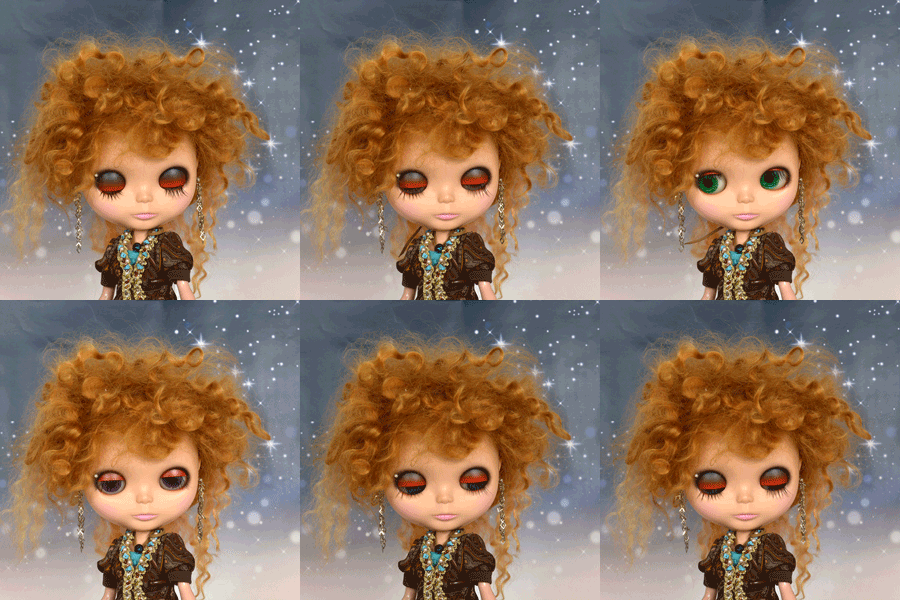
The modern chapter belongs to the customizers. Artists take Blythe as a canvas: carving lips, repainting faces, swapping eye chips, rerooting hair, and sewing wardrobes, until each doll is a one of a kind character. What began as a niche craft is now a global art movement spanning every continent.
This Is Blythe has been part of that story since 2000, growing from a love letter to a forgotten doll into the world's largest custom Blythe studio, handmaking dolls for collectors in more than 200 countries, a journey we celebrated in our 26th anniversary love letter.

New to the doll herself? Start with what is a Blythe doll for sizes and the eye mechanism, learn the craft in how to customize a Blythe doll, or meet the doll who shares your face with the free look-alike finder.
Blythe was designed by Allison Katzman at the toy design firm Marvin Glass and Associates and produced by the Kenner toy company in the United States in 1972.
The original Blythe was sold by Kenner in 1972 for roughly one year. New editions began production in Japan in 2001, and handmade custom Blythe dolls have been made continuously since 2000.
Children in 1972 found the oversized head and color changing eyes unsettling, and sales were poor. Kenner ended the line after about one year, which is why original dolls are so rare today.
Photographer Gina Garan revived interest in the late 1990s with her Blythe photography and the 2000 book This Is Blythe. A Japanese TV commercial for the Parco department store in 2000 sparked such demand that new editions entered production in Japan in 2001.
Yes. Because the original run lasted only one year, vintage Kenner Blythes usually sell for $1,000 to $4,000 or more depending on condition, and even loose original parts sell for hundreds.
Own a piece of the story
Every handmade custom Blythe doll continues a story that began in 1972 and refused to end. Browse the bestsellers collectors order most, explore custom Blythe doll full sets, or design your own chapter in the build your own studio.
It is sad they weren’t a hit with little kids. My niece who is 7 always asks to look at Blythe dolls online with me when she visit. I told her you can’t find them in stores and they aren’t cheap. Hopefully one day we can customize one together.

Say hello to Jenna Anderson — our Customer Happiness Director and resident Blythe doll devotee. Affectionately known around the studio as the “Blythe Whisperer,” Jenna spends her days helping collectors find the doll that feels unmistakably theirs, and her evenings writing the stories you read here. Her warmth, eye for detail, and genuine love of these big-eyed characters make her the heart of the This Is Blythe community.
When she steps away from the inbox, you'll find her sewing tiny doll-sized accessories, behind a camera, or lost in some new arts-and-crafts project — the same curiosity and care she pours into every doll. Read more about Jenna's journey into the world of Blythe here.
New posts, doll drops & members-only deals — straight to your inbox.
No spam, just dolls. Unsubscribe anytime.
Here's your code — tap copy, then use it at checkout.
Your welcome code
BFF26BYNWUse it on any new order — we've emailed it to you, too. Every order ships free worldwide with a 30-day guarantee. 💕
Free Worldwide Shipping | 30-Day Money-Back Guarantee
© 2026 This Is Blythe Official Website. All rights reserved.
The world’s top custom Blythe doll maker since 2000.
Cookie Policy | Accessibility Statement | Do Not Sell or Share My Personal Information | Ethics & Compliance | GDPR & CCPA Compliance | Data Processing Agreement | Trust Certificate | DMCA