Those giant, colour-changing eyes are the first thing everyone notices. Here is where they really came from, and why we still cannot look away.
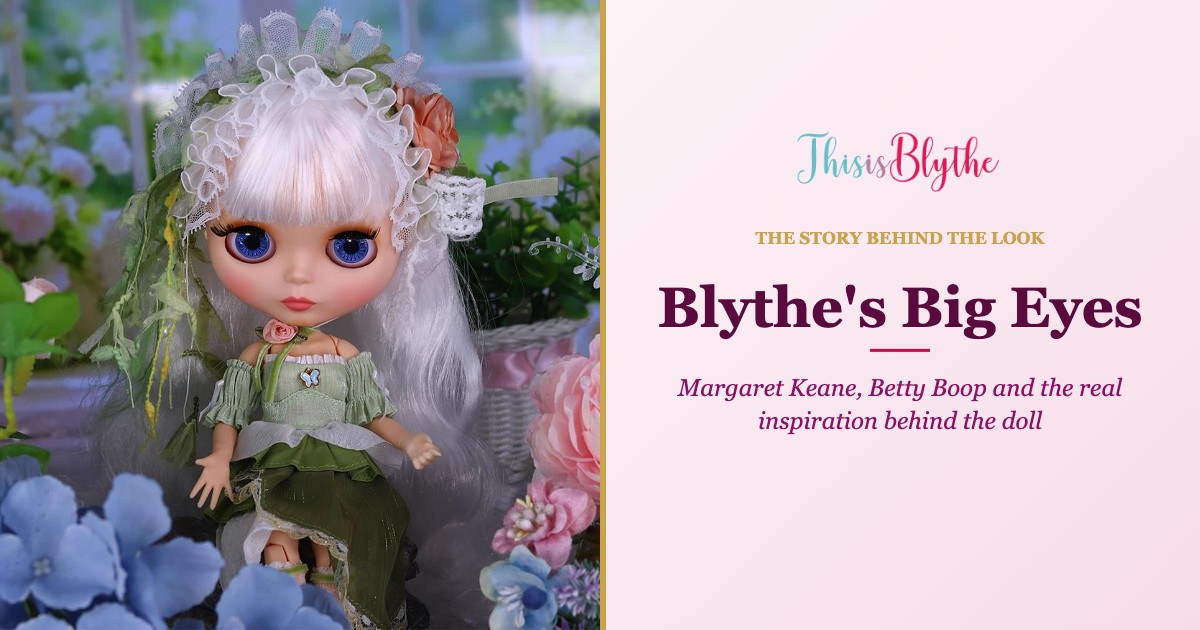
Ask anyone what they remember about Blythe and they will say the same thing: Blythe’s big eyes. They are huge, glossy, slightly sideways, and they change colour when you pull a string at the back of her head. Half of the internet finds them enchanting. The other half finds them a little bit spooky. Almost nobody forgets them.
So where did Blythe’s big eyes come from? Collectors often point to Margaret Keane, the painter of the famous “Big Eyes” children. It is a lovely theory, and the two stories really do belong together. But the designer’s own story is a little different, and in our opinion, even better.
Blythe was designed by Allison Katzman, a toy designer born in Oregon in 1925. She spent more than 50 years designing toys in Chicago for the famous toy design firm Marvin Glass and Associates, and later for Meyer/Glass, and she held more than 30 design patents. According to her family’s published obituary, Blythe, with her “unique eye-color changing mechanism”, was one of her best-known designs.
Kenner launched Blythe in 1972. She was on shelves for only about a year. Children found her oversized head and enormous eyes a little unsettling, sales were disappointing, and she quietly disappeared. The Victoria and Albert Museum keeps an original 1972 Kenner Blythe in its collection today and describes her perfectly: “a typically oversized head with large eyes on a small body.”
Allison Katzman passed away in Seattle in February 2020, at the age of 95. She lived long enough to see the “failed” doll she designed become one of the most loved collector dolls in the world.

When Katzman died, the Chicago Sun-Times interviewed her family about the doll. Two inspirations came up, and neither of them was a painting.
You can read the story in the Sun-Times piece, republished here.
Her dolls were ahead of their time: not quite right for children in 1972, perfect for grown-up collectors fifty years later.This Is Blythe
If you grew up in the 1960s, big eyes were everywhere. Margaret Keane’s paintings of sad-eyed waifs were one of the biggest pop-art crazes of the decade, sold as prints, postcards, plates and mugs, and even praised by Andy Warhol.
For years, though, the world believed they were painted by her husband, Walter Keane, who took the credit and the money. Margaret finally told the truth, and in 1986 the dispute ended up in a Honolulu courtroom. The judge asked both of them to paint a big-eyed child in front of the jury. Walter declined, saying his shoulder hurt. Margaret finished her painting in under an hour. The jury sided with her, although the damages she was awarded were later overturned and she never collected them.
Her story became Tim Burton’s film Big Eyes in 2014, with Amy Adams playing Margaret. Margaret Keane died in Napa, California, in June 2022, at the age of 94. CNN’s obituary is a beautiful read.
So, did Keane inspire Blythe’s big eyes? There is no record that Katzman ever said so. What is fair to say is that Blythe was born into a culture that had fallen in love with big eyes, and Keane was the most famous face of that love. Collectors who hang a Keane print next to their Blythe shelf are not wrong to feel the connection. They are simply connecting two different women who changed how we see “cute”.
There is real science behind the pull of a big-eyed face. Scientists call it the “baby schema”: a set of features like a round face, a high forehead and large eyes that our brains read as young and in need of care. In a well-known 2009 study published in Ethology, adults rated faces with stronger baby-schema features, including bigger eyes, as cuter, and felt more motivated to take care of them.
Blythe’s big eyes are the baby schema turned all the way up. Her head is enormous compared with her body, her face is round and smooth, and her eyes take up a huge part of it. That is why so many people have the same reaction the first time they see a doll with big eyes like hers up close: a little gasp, and then “I want one”.
It is also why Blythe photographs so well: Blythe’s big eyes hold light. Tilt her head towards a window and the eye chips catch a gleam that makes her look alive.
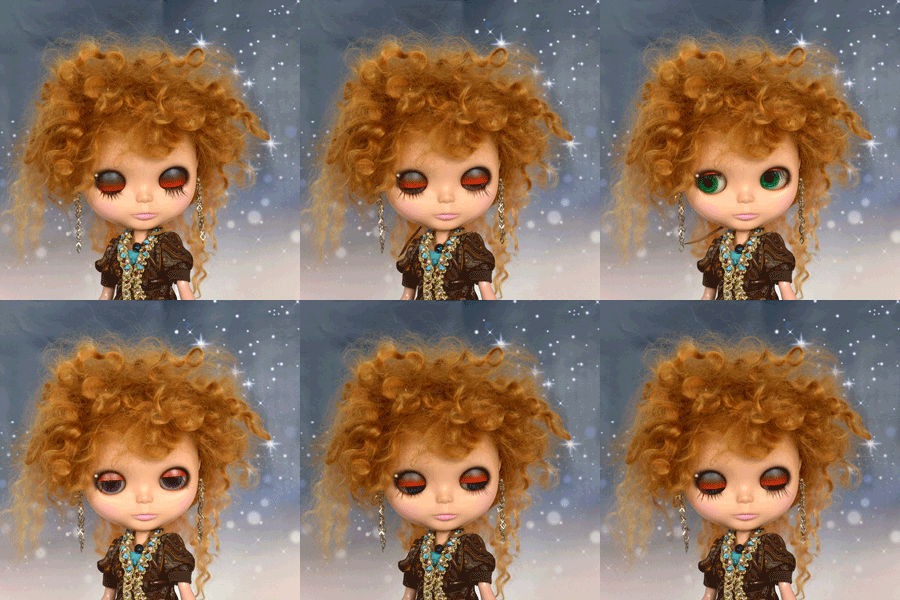
Inside every Blythe head is a small mechanism holding four pairs of eye chips. Pull the string at the back of her head and the mechanism rotates to the next pair, changing both the colour and the direction of her gaze.

Blythe’s big eyes are where a custom doll really becomes someone. When we hand-finish a doll, the eye chips are one of the first things we think about, because they change the whole mood of the face.
Our artists’ rule of thumb
Match one pair to the person’s real eye colour, then choose three that suit her personality. Soft blues and greens feel gentle. Warm browns and ambers feel cosy. Violet and pink feel playful and a little bit magical.
If you want a doll that looks like you, or like someone you love, you can design her yourself in our build-your-own Blythe studio, or upload a photo to our free look-alike finder. If you already have a doll and want to change her look, our Blythe eye chips come in dozens of colours and styles.
Design a Blythe with your eye colour
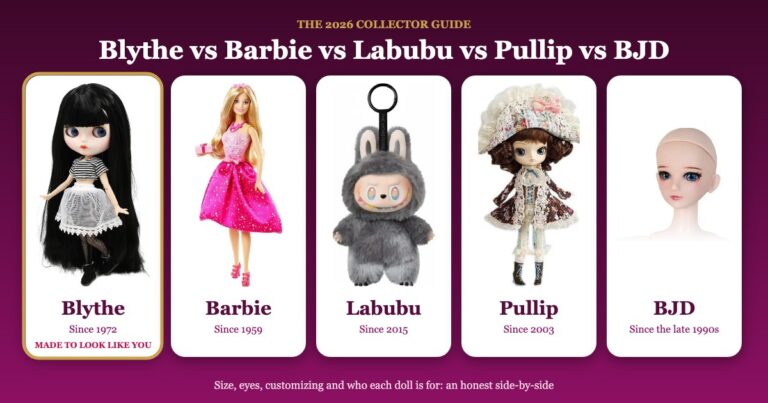
If you love the history side of Blythe, these are the natural next stops: the full story of Blythe dolls, who created Blythe, and our honest comparison of Blythe vs Barbie, Labubu, Pullip and BJD.
With love, This Is Blythe Team
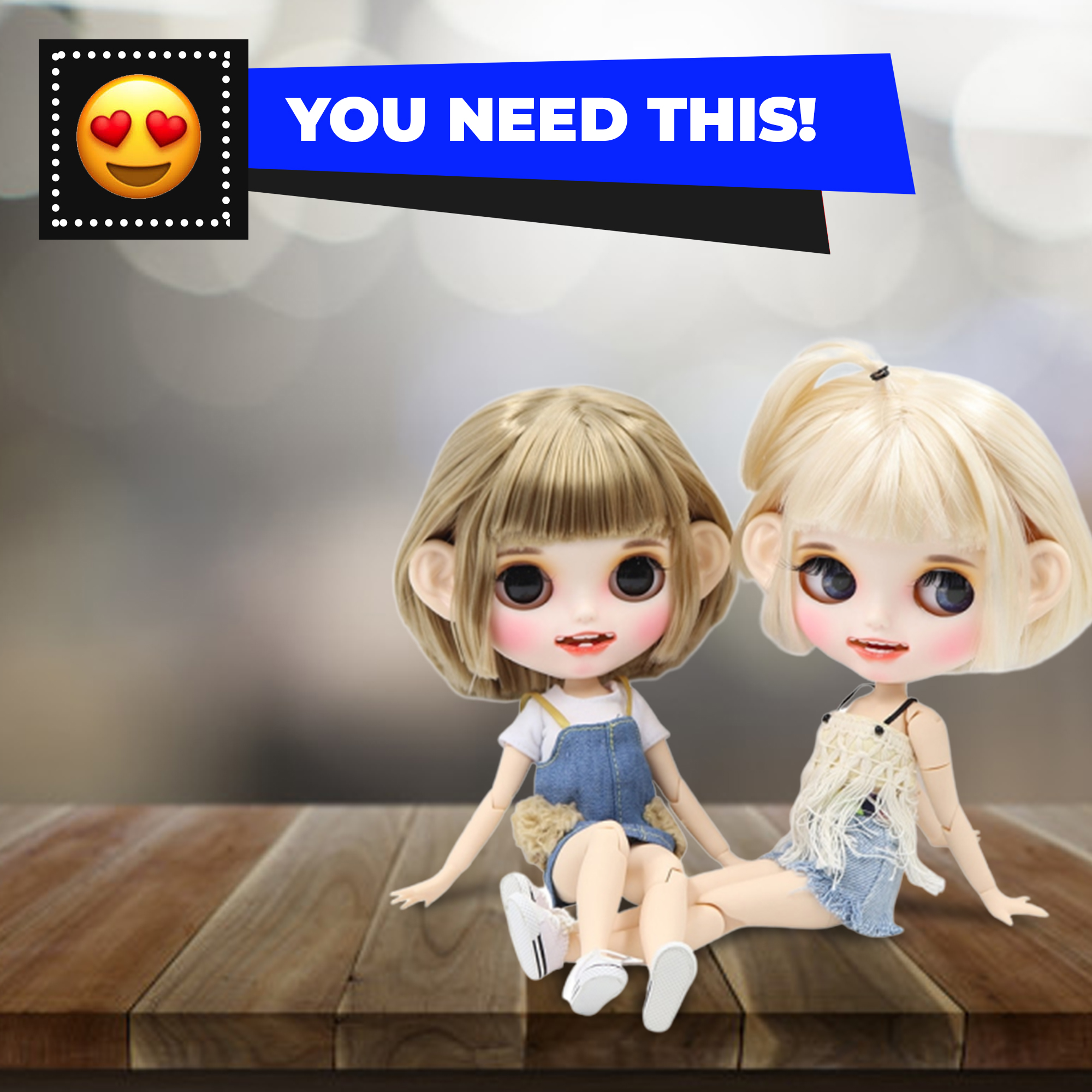
I’m very happy to learn that I’m not the only man who has a love of doll collecting like Johnny Depp. I like to see if other male doll collectors share this great hobby. Cheers to all the the doll collectors in the world and remember we are not strange for being from USA.
Say hello to Jenna Anderson — our Customer Happiness Director and resident Blythe doll devotee. Affectionately known around the studio as the “Blythe Whisperer,” Jenna spends her days helping collectors find the doll that feels unmistakably theirs, and her evenings writing the stories you read here. Her warmth, eye for detail, and genuine love of these big-eyed characters make her the heart of the This Is Blythe community.
When she steps away from the inbox, you'll find her sewing tiny doll-sized accessories, behind a camera, or lost in some new arts-and-crafts project — the same curiosity and care she pours into every doll. Read more about Jenna's journey into the world of Blythe here.
New posts, doll drops & members-only deals — straight to your inbox.
No spam, just dolls. Unsubscribe anytime.
Here's your code — tap copy, then use it at checkout.
Your welcome code
BFF26BYNWUse it on any new order — we've emailed it to you, too. Every order ships free worldwide with a 30-day guarantee. 💕
Free Worldwide Shipping | 30-Day Money-Back Guarantee
© 2026 This Is Blythe Official Website. All rights reserved.
The world’s top custom Blythe doll maker since 2000.
Cookie Policy | Accessibility Statement | Do Not Sell or Share My Personal Information | Ethics & Compliance | GDPR & CCPA Compliance | Data Processing Agreement | Trust Certificate | DMCA